
Start with the records.
Merer’s logbooks record limestone transport from Tura to Khufu’s pyramid project. They provide direct evidence for a transport operation, but do not explain the complete lifting sequence.
Episode 04 · With Ethan · 2 min 40 sec
Follow one stone. Three challenges: reach the site, move across the ground, and climb toward the sky.
The complete story · One short film
Follow the journey from river transport to the uphill challenge, with cinematic illustrations, clear explanations and the evidence behind them.
AI-generated presenter and illustrative scenes. The stone’s journey is imagined; the ramp around the pyramid is one proposed configuration, not a proven reconstruction.
Watch on YouTube ↗ (opens in a new tab)Explore the evidence ↓Inside the episode
Building the Great Pyramid required more than lifting heavy objects. Materials had to arrive, crews had to move them, and hauling routes had to remain usable as the monument grew. Following an imagined casing stone helps separate these problems without pretending that every stage is historically settled.
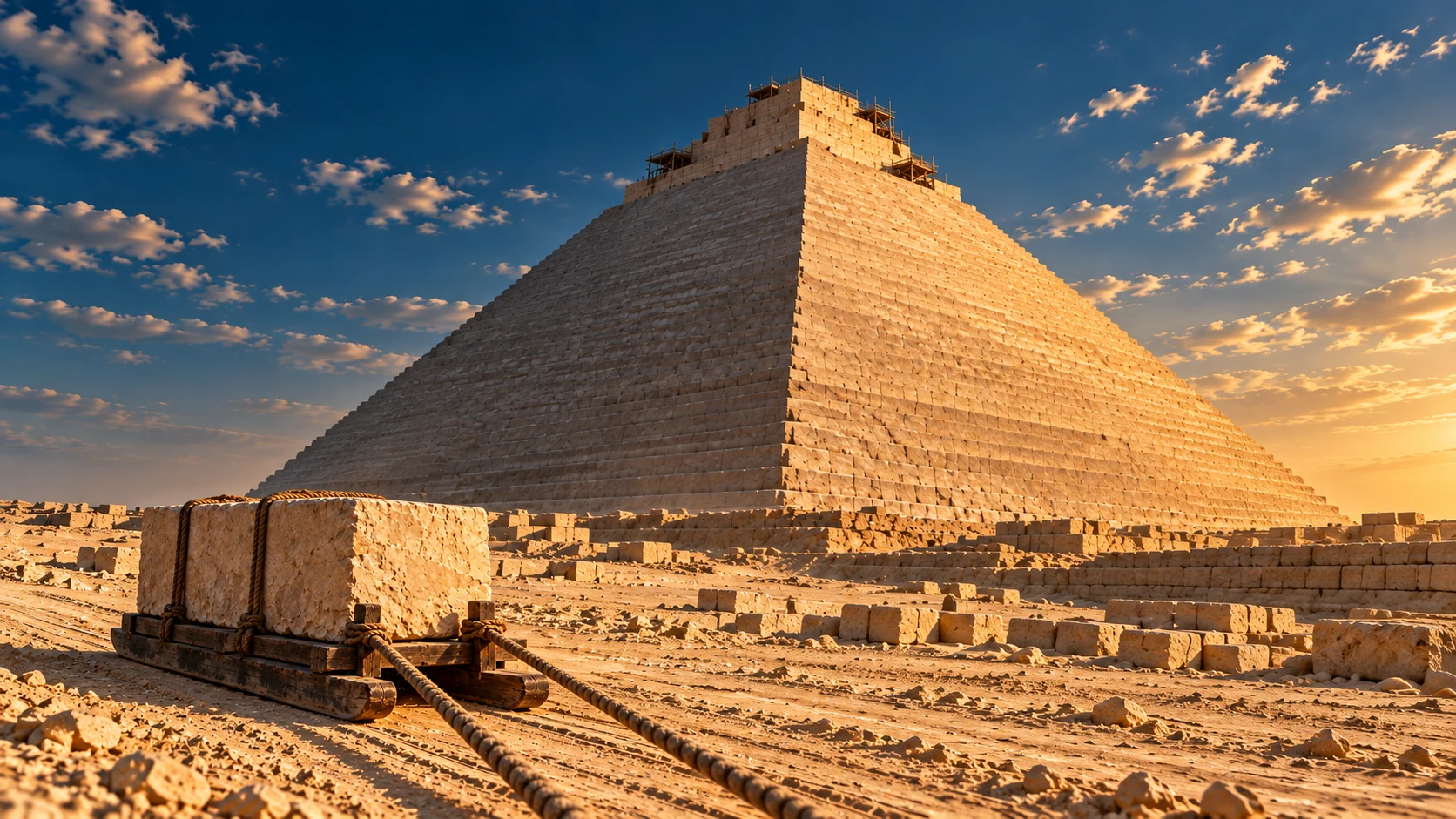
Merer’s logbooks record limestone transport from Tura to Khufu’s pyramid project. They provide direct evidence for a transport operation, but do not explain the complete lifting sequence.
Laboratory experiments found that suitable moisture can stiffen sand and reduce the force needed to pull a sledge. The effect depends on conditions; too much water can increase friction again. This is a physical mechanism, not a measurement of an ancient crew’s performance.
03 · Gaining height
In an idealized, frictionless model, a longer ramp reaching the same height reduces the steady pulling force along its slope. Doubling that length halves the force, while doubling the distance. The work against gravity remains the same. Real hauling must also overcome friction and accommodate steering, deliveries and safe working space.
The ramp and associated features documented at Hatnub offer clues to ancient hauling techniques. Hatnub is an alabaster quarry, however—not the Great Pyramid. A plausible ramp configuration does not by itself establish what the builders actually did.
Questions, answered
It documents part of the limestone transport operation. It does not describe the complete route by which stones were lifted and placed in the pyramid.
No. Moisture can change the mechanical behavior of sand and reduce pulling resistance under suitable conditions. The load still has weight, and raising it still requires work against gravity.
No complete lifting sequence is established here. Archaeological clues and engineering models constrain possibilities, but feasibility alone does not prove historical use.
Explore further
Publisher’s record of the transport logbooks; evidence for deliveries, not the complete lifting method.
Laboratory research on moisture and sliding resistance.
Field evidence from a quarry hauling system, with limits on extrapolation to Giza.
Source links open in a new tab. Conceptual visuals explain ideas; they are not archaeological evidence.

Keep exploring · Episode 03