
Build on suitable ground.
Draining the riverbed is only the beginning. Sediment and unsuitable material must be removed, and the exposed foundation cleaned and treated. A large concrete dam depends on the rock supporting it. Source 3
Episode 07 · Dam construction · 2 min 57 sec
A dry construction site inside a flowing river. A hidden route through the mountain. And a challenge growing inside the concrete itself.
The complete story · One short film
Follow one way engineers make room for a dam without stopping the river’s journey downstream.
AI-generated presenter and simplified illustrative scenes. This is a generic explanation, not footage of a specific project.
Watch on YouTube (opens in a new tab)Explore the explanationThe key idea
Engineers can send the river around the construction area through a diversion tunnel. Temporary barriers, called cofferdams, isolate the riverbed while pumps remove trapped water and manage seepage. Crews then prepare the foundation and build the main dam. Other sites use diversion channels or construct the dam in stages.
Inside the episode
The tunnel inlet sits upstream of the construction area and its outlet downstream. An upstream cofferdam directs flow toward the bypass; a downstream barrier helps keep water from backing into the worksite. The construction basin between them can then be drained. Sources 1–2
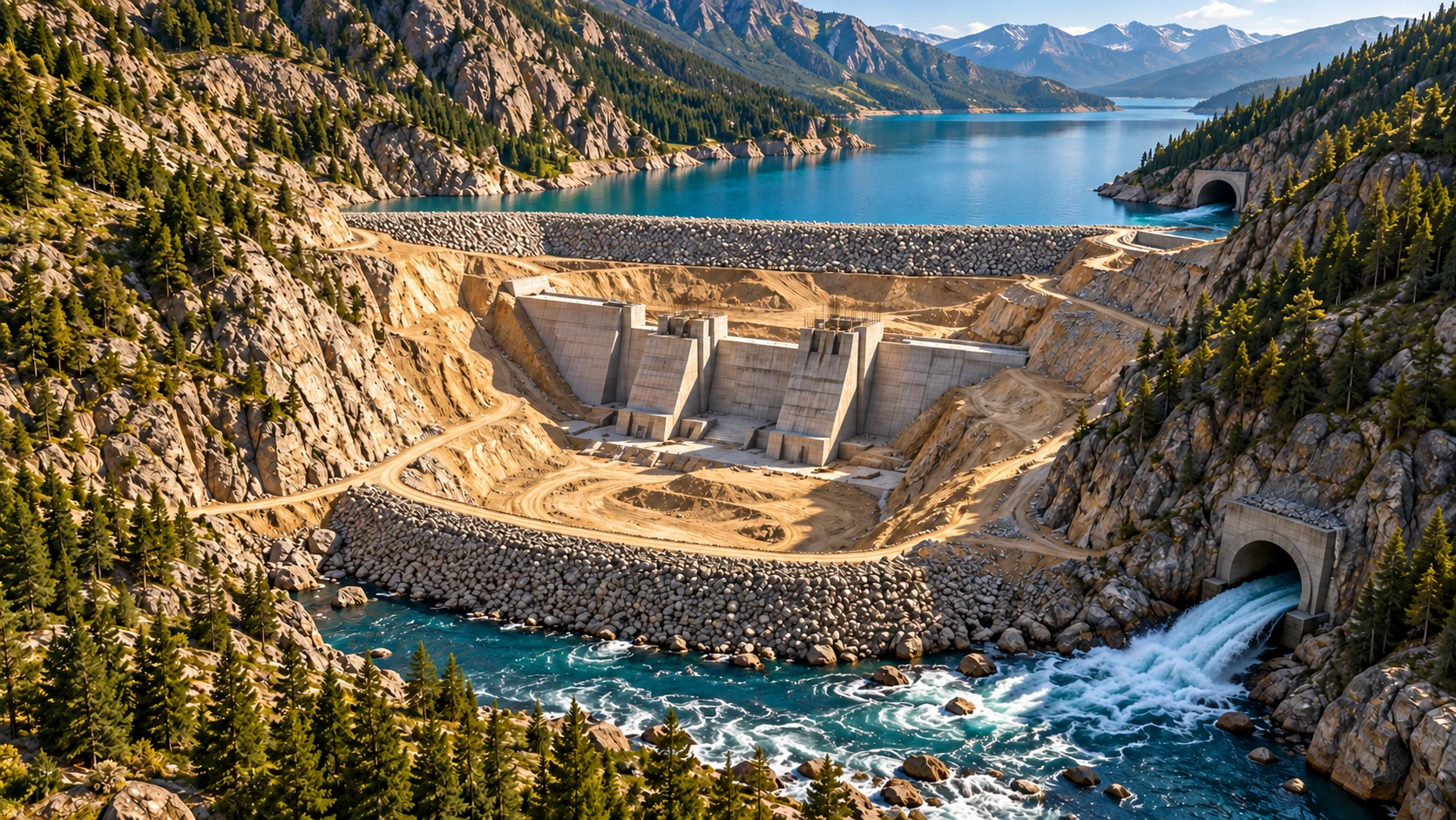
Draining the riverbed is only the beginning. Sediment and unsuitable material must be removed, and the exposed foundation cleaned and treated. A large concrete dam depends on the rock supporting it. Source 3
Cement releases heat as it reacts with water. Temperature differences and restrained cooling can create stresses and cracking. Mix design, placement temperature and construction sequence help control this; some dams also use embedded cooling pipes. Source 4
Once the structure is ready, the diversion arrangement is closed or regulated according to the design. Initial reservoir filling follows a planned program, allowing engineers to observe the dam and foundation as water levels rise. Source 5
Questions, answered
They isolate the worksite from both directions. The upstream barrier redirects the incoming river; the downstream barrier limits water backing into the excavation. Pumping is still needed for trapped water and seepage. Sources 1–2
Large concrete placements retain heat. Engineers plan blocks, layers and temperature control to manage thermal stresses. Water circulated through embedded pipes can remove heat from the concrete; this is one available method, not a feature of every dam. Source 4
A basin downstream of a spillway or outlet dissipates energy from fast-moving water and helps protect the riverbed against erosion. In a hydraulic-jump basin, shallow fast flow changes into deeper turbulent flow. Other energy-dissipation arrangements are also used. Source 6
No. The terrain, geology, river flows and construction sequence determine the diversion arrangement. A tunnel is one approach; diversion channels and staged construction are alternatives. The film illustrates a method, not a universal sequence.
The presenter, cover and construction scenes are AI-generated. The layout and machinery simplify the process and are not intended to show exact dimensions, equipment connections or a buildable design. Historical project accounts below document examples of the methods; the episode itself is not tied to those projects.
Explore further
An official construction account documenting a river bypass through canyon walls.
How temporary upstream and downstream barriers isolated a dam worksite.
Construction history covering dewatering, foundation excavation and grouting.
Documented use of concrete blocks, lifts and embedded water-cooling pipes.
General outlet works design considerations; Appendix C provides first-filling guidelines.
Definitions of cofferdams, hydraulic jumps, spillways and stilling basins.
References checked October 2, 2026. Project-specific dimensions and construction details should not be generalized to every dam.
Keep exploring · Episode 06
Published by MAKESTEAD · Page updated October 4, 2026 · Our sources and editorial approach